


Key Takeaways
- South Korean prosecutors have indicted five suspects in the country’s first-ever criminal case over a DEX rug pull.
- CATFI’s Solana rug pull left 256 investors with 900 million won in losses, with organizers pocketing 400 million won.
- The landmark case has set a precedent as to how onchain evidence can pierce decentralized platform anonymity.
CATFI, a Fake Influencer, and a DEX Exit
The case centers on a meme coin called CATFI, which launched on a Solana-based decentralized exchange ( DEX), a trading platform that operates without a central authority or the listing checks required on traditional exchanges.
According to prosecutors, the group behind CATFI quietly accumulated a large position in the token before publicly promoting it through a social media influencer persona called “Eth Father.” The character was controlled by the alleged ringleader, identified only by the surname Park.
Park and his associates promoted CATFI to retail audiences as if they were disinterested third parties, manufacturing the appearance of organic community interest. Once the token’s price had been pumped and retail buyers had entered, the group allegedly pulled the liquidity, crashing the price and leaving 256 investors with combined losses of approximately 900 million won (roughly $600,000).

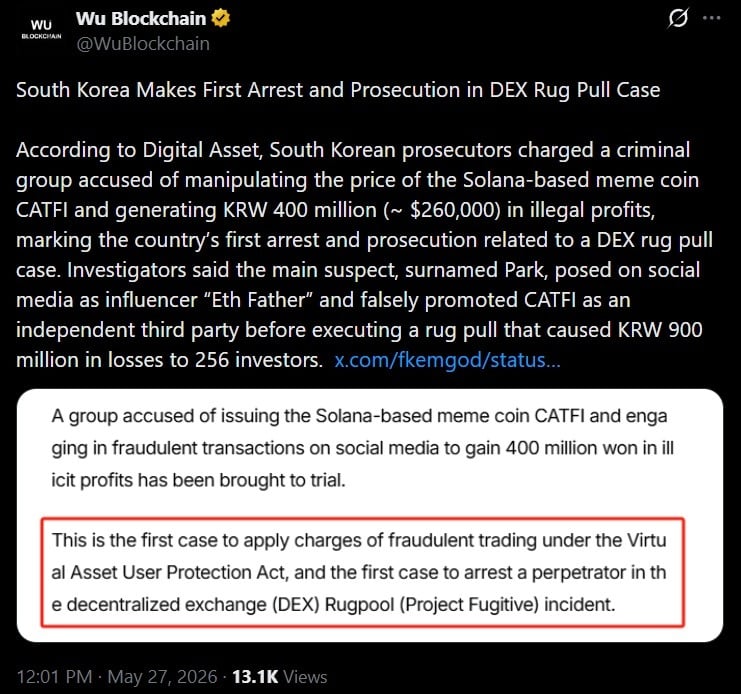
The organizers are accused of pocketing around 400 million won, approximately $260,000, in illegal profits. All five suspects have been formally indicted by prosecutors in Seoul.
Investigators built the case using onchain analysis to trace wallet addresses linked to the scheme, alongside social media evidence tying the “Eth Father” promotional accounts back to Park and the four co-accused.
The prosecution is significant because DEXs have long existed in a regulatory gray zone, allowing tokens to be issued and listed on them without centralized approval processes. In this regard, South Korea has been sharpening its crypto enforcement posture throughout 2026.
Earlier this year, the country introduced requirements for five-minute reconciliations and automated kill switches. Moreover, in January, authorities signaled a broader crypto policy push that included reconsidering the country’s long-standing ban on spot bitcoin ETFs.
Finally, a new Digital Asset Act introduced earlier this year ushered in a 100% reserve requirement for stablecoins, all while the country saw $110 billion in crypto outflows (through 2025). The latter figure shows just how much enforcement and regulatory pressure have shaped local market behavior.