
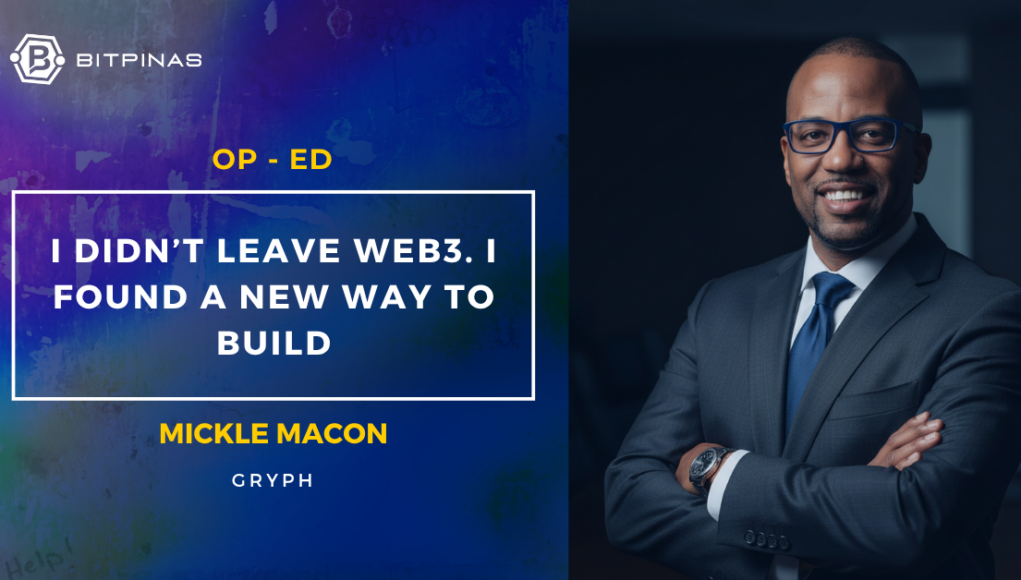
By Mickele Macon
How AI-assisted music gave Gryph an executable path forward without abandoning its larger mission of creator ownership
If you have followed Gryph over the past five years, you may have wondered where we have been.
Some people assumed we disappeared. Others thought we had abandoned Web3.
The truth is simpler.
We never stopped building.
The author is the Founder and CEO of Gryph and the founder of Gryph Recordings and therefore has a direct professional interest in the projects discussed in this article. The experiences, claims, and opinions expressed are the author’s own.
I entered Web3 because I believed it represented something much larger than cryptocurrency. I saw blockchain as a technology that could transform creator ownership, digital identity, community participation, and the ways independent entrepreneurs build businesses without relying entirely on traditional gatekeepers.
That belief became Gryph.
Over the years, we explored NFT collections, experimented with digital fashion through Gryph Streetwear, developed Gryph Naming Service, published articles about blockchain, participated in Web3 communities, and refined larger startup concepts that we believed could create meaningful change.
The objective was never simply to launch another NFT collection.
The vision was to build a company that empowered creators through technology.
What Bootstrapping Actually Teaches You
Like thousands of startup founders, we followed the familiar playbook.
We marketed online. We spent countless hours speaking in Twitter, now X, Spaces about decentralized technology. We attended conferences whenever possible, hired marketers when we could afford them, built teams, lost team members, and rebuilt.
We applied to accelerators and grant programs. We pitched investors. We were even featured on The Final Pitch.
Every experience taught us something. Every attempt moved Gryph forward.
But none produced the breakthrough we hoped for.
It was not because the ideas were bad or because we lacked conviction. It was because building a bootstrapped technology company is extraordinarily difficult.
When founders finance development themselves, every dollar matters. Hiring skilled developers is difficult. Retaining them can be even harder.
People get married. They have children. They accept full-time positions. Their responsibilities change.
Life happens.
Founders eventually learn that ideas are rarely the greatest obstacle.
Execution is.
Over time, I realized that waiting for the perfect team was preventing me from creating anything at all.
One of our larger blockchain projects remained on the shelf. We still believe in it today, but it requires a dedicated engineering team, significant development resources, and the right market timing.
That timing has not arrived yet.
Instead of continuing to wait, I asked myself a question that nearly every founder must eventually confront:
What can I build today?
Returning to Music
That question led me back to something I had loved for most of my life.
Music.
I have spent more than 30 years writing songs, producing beats, developing artists, and working behind the scenes in different areas of the music industry.
I never abandoned music. Life simply carried me deeper into entrepreneurship, technology, and Web3.
Then, in September 2025, a friend introduced me to Suno, an AI-assisted music platform.
At first, I was simply curious. Like many creators, I wanted to understand what generative music technology could actually do.
When Version 5 was released, I wrote lyrics, developed a production prompt, and generated a song.
Within minutes, I heard something that changed the way I thought about creative execution.
It was not because AI had replaced musicians.
It was because it had removed several barriers that independent creators have struggled with for decades: finding vocalists, coordinating musicians, booking studios, scheduling recording sessions, waiting weeks for production, and paying substantial costs before an audience had heard a single song.
For the first time, I could remain inside the creative process without repeatedly stopping to solve logistical problems.
The technology was not inventing my ideas.
It was helping me execute them.
That distinction changed everything.
Thirty Songs in Thirty-Six Hours
Within 36 hours, I completed my first 30-song album.
Not because I was trying to race through the process, but because I could not stop creating.
Ideas that had lived in notebooks for years suddenly had voices. Songs that had existed only as hooks, verses, or unfinished concepts became full productions.
Creativity was no longer waiting for logistics to catch up.
Creativity was leading the process.
After several conversations with my angel investors, we reached the same conclusion. Given my background in music, my existing library of original beats and samples, my decades of songwriting experience, and the opportunities created by AI-assisted production, launching a record label made more sense than waiting indefinitely for another blockchain product to receive the resources it required.
That decision became Gryph Recordings.
Some people might describe it as a pivot.
I see it as execution.
Rather than waiting for one part of our vision to become possible, we began building another part of the same creator ecosystem.
Building Gryph Recordings
Since September 2025, Gryph Recordings has grown into an independent label with five original artist projects:
K1NG BL4Z3, C0D3 S1GN4L, S0L4R., Sav4nna, and R34L G’s.
Each project has its own musical identity, visual language, concepts, releases, and audience. Behind them, however, is the same creator-directed process.
I write the lyrics.
I develop the concepts and artist identities.
I direct the production.
I create and organize the samples and musical textures.
I design the visual branding.
I master the releases.
I build the websites.
I produce the campaigns and promotional content.
AI did not replace my creativity. It expanded my ability to execute it.
Since launching Gryph Recordings, I have completed and mastered 18 full-length albums, along with hundreds of additional recordings, alternate versions, edits, remixes, and future singles.
I also built the Gryph Recordings website by combining my coding experience with modern AI-assisted development tools. It became the second website I had built from the ground up.
Once again, technology was not replacing the builder.
It was giving the builder a larger toolbox.
Music Is Already About Ownership
Does this mean Gryph has left Web3 behind?
Absolutely not.
Music may be one of the clearest real-world applications for many of the principles Web3 has discussed for years.
Music is about ownership.
It is about identity, community, collectibility, attribution, and the relationship between artists and their supporters.
These are not new ideas created by blockchain. They have always existed in creative industries. Web3 gives us different tools for organizing and strengthening them.
Streaming remains the dominant infrastructure for music today. It gives independent creators access to global distribution and allows listeners to discover music instantly.
But streaming does not have to be the final form of the relationship.
The future could also include limited digital editions, token-gated experiences, blockchain-authenticated collectibles, on-chain fan communities, verifiable credits, digital merchandise, and new ways for supporters to participate in the worlds surrounding the music they love.
Web3 does not need to replace streaming for it to matter.
It can add new layers of ownership, participation, and connection around it.
The Mission Did Not Change
I wanted to write this article because people who supported Gryph during its earlier Web3 journey deserve to know what happened next.
We did not disappear.
We did not abandon blockchain.
We continued experimenting, learning, and creating.
Every startup reaches moments when its original roadmap no longer matches the resources or opportunities directly in front of it.
Changing the roadmap does not necessarily mean abandoning the destination.
Sometimes the strongest founders are not those who stubbornly follow one route regardless of conditions. They are the ones who find another way forward while keeping the larger mission intact.
Gryph Recordings is that path for us.
It allows us to continue building a company, developing intellectual property, growing a community, experimenting with emerging technology, and creating meaningful work while the next blockchain chapter of Gryph continues to mature.
The medium has changed.
Listen to our latest episode
The mission has not.
To everyone who supported Gryph through its Web3 journey, thank you.
I hope you will join us for this next chapter.
Music is not the end of our story.
It is the soundtrack to everything still to come.
About the Author
Mickele Macon is the Founder and CEO of Gryph, a Web3 ecosystem launched in 2021, and the founder and executive producer of Gryph Recordings. He has been active in blockchain since 2017 and has more than 30 years of experience writing songs, producing music, creating original beats and samples, and developing artists.
His professional background also includes cybersecurity, finance, digital identity, entrepreneurship, and decentralized technology. He appeared on The Final Pitch Season 8: The Tech Edition and graduated from the Alibaba Netpreneur Masterclass in 2025.
Through Gryph and Gryph Recordings, he continues exploring the intersection of AI-assisted creation, intellectual property, creator ownership, digital communities, and Web3.
Disclosure
The author is the Founder and CEO of Gryph and the founder of Gryph Recordings and therefore has a direct professional interest in the projects discussed in this article. The experiences, claims, and opinions expressed are the author’s own.
This article is published on BitPinas: [Op-Ed] Mickele Macon: How AI-Assisted Music Helped Gryph Keep Building Its Web3 Vision
What else is happening in Crypto Philippines and beyond?