
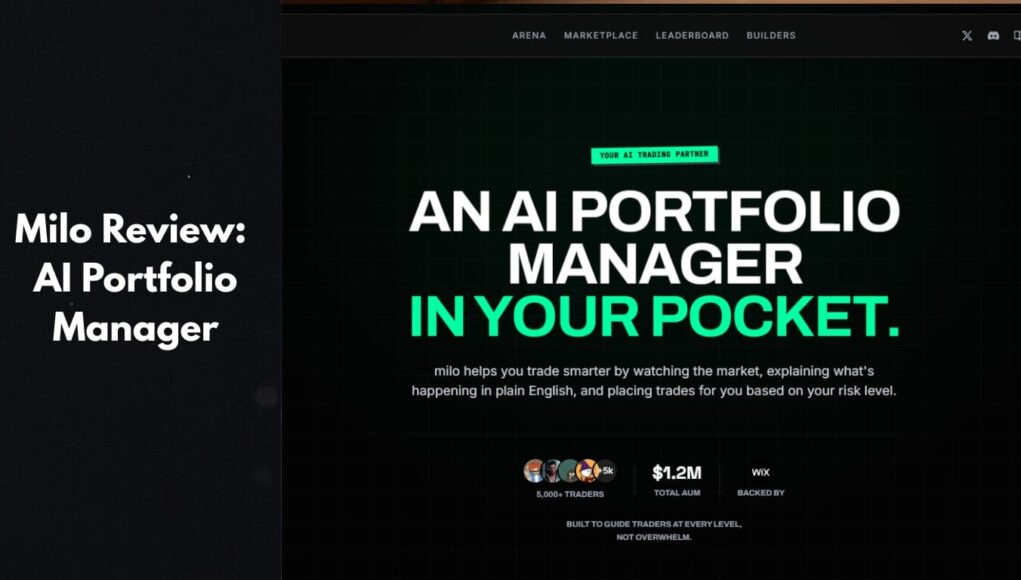
Crypto portfolio management is still a mess for most retail traders. Too many tabs, too many signals, too little structure. Milo is an AI portfolio manager built specifically for the Solana ecosystem that replaces that chaos with a disciplined, always-on system that reads the market the way a professional would and explains every decision in plain English. This review covers how Milo works, what it does well, where it falls short, and who it is actually built for.
What Is Milo?
Most crypto traders operate in a state of managed chaos. Tabs open everywhere, Twitter threads half-read, gut feelings dressed up as strategy. Milo exists to replace that chaos with something rarer in crypto: clarity.
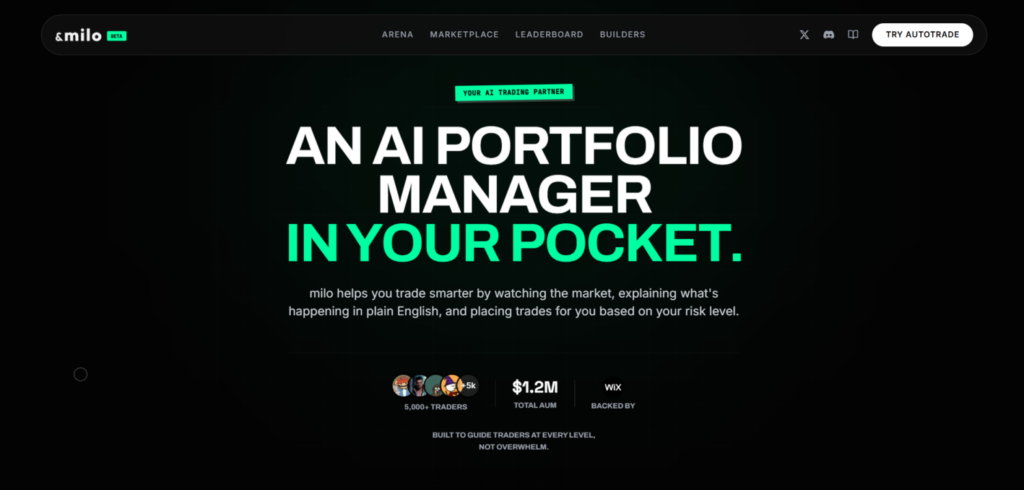
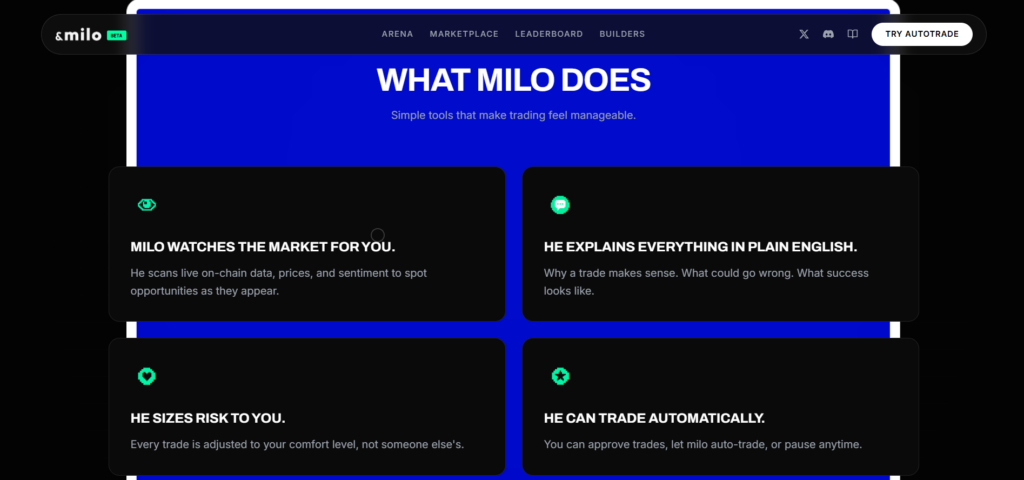
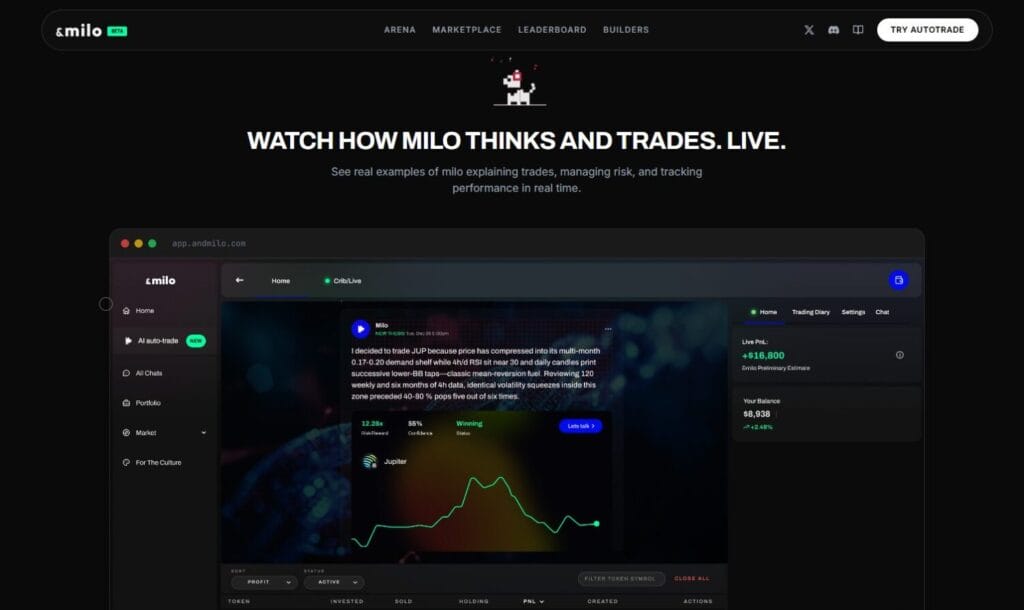
Milo is an AI portfolio manager built specifically for the Solana ecosystem. It reads on-chain activity, market data, and social sentiment simultaneously, synthesises all of it through a reasoning engine, and produces plain-English investment theses that explain exactly what is happening, what might happen next, and why any of it matters. It does not shout signals. It thinks, then explains.
As of 2026, Milo has over 5,000 active autonomous traders on the platform, more than $1 million in assets under management, and over 100,000 transactions executed in a single month with zero human clicks required.

How Milo Reads the Market
Milo builds its market understanding through three data sources working simultaneously.
- The first is on-chain data pulled directly from Solana RPC nodes. This is raw blockchain activity: liquidity shifts, whale movements, inflows and outflows, and volatility signals that no one needs to interpret because the chain itself generates them.
- The second is market data from providers like Birdeye and Solana Tracker. Price, volume, depth, historical movement, and market structure arrive through these feeds and give Milo the instrument panel view of what the numbers are actually doing.
- The third is social sentiment through Cookie3, which tracks narrative momentum across the crypto space. Traders talk before charts move. Milo listens to this layer because real markets are shaped by human conviction, not just algorithms.
These three data streams feed a reasoning engine that behaves like a disciplined portfolio manager. It does not jump to conclusions. It asks what is changing, what is stable, what looks like noise, and what looks meaningful. When the picture becomes clear, it writes a thesis.
Key Features
Investment Thesis Engine
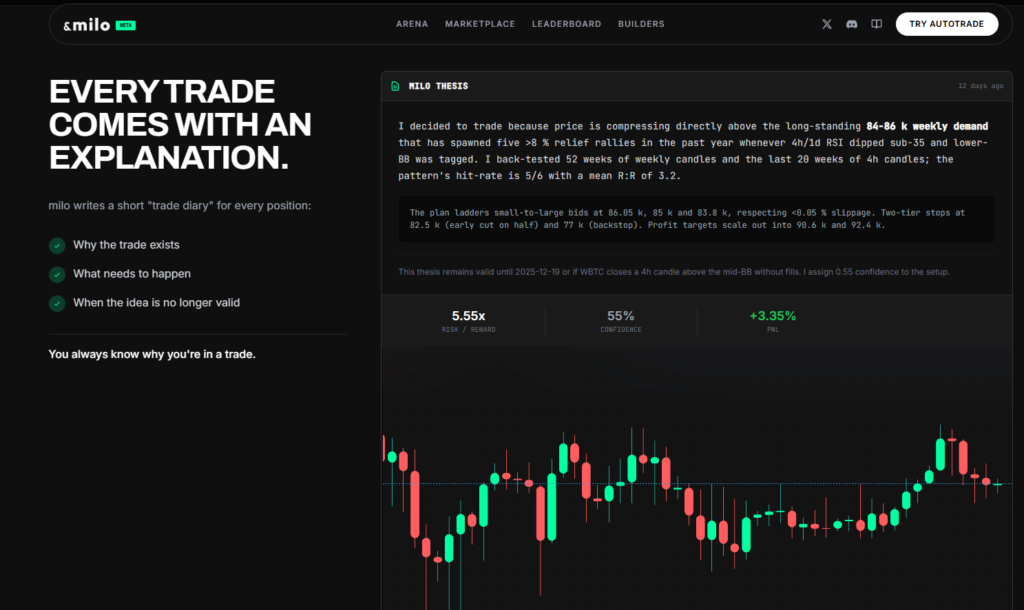
Every thesis Milo generates reads like a memo from a senior data analyst, not a signal bot alert. It covers the supporting evidence, the risks, the invalidation point, the reward potential, and the step-by-step logic behind the position. Traders who have always wanted someone to sit beside them and explain market structure in real time now have exactly that.
AutoTrade
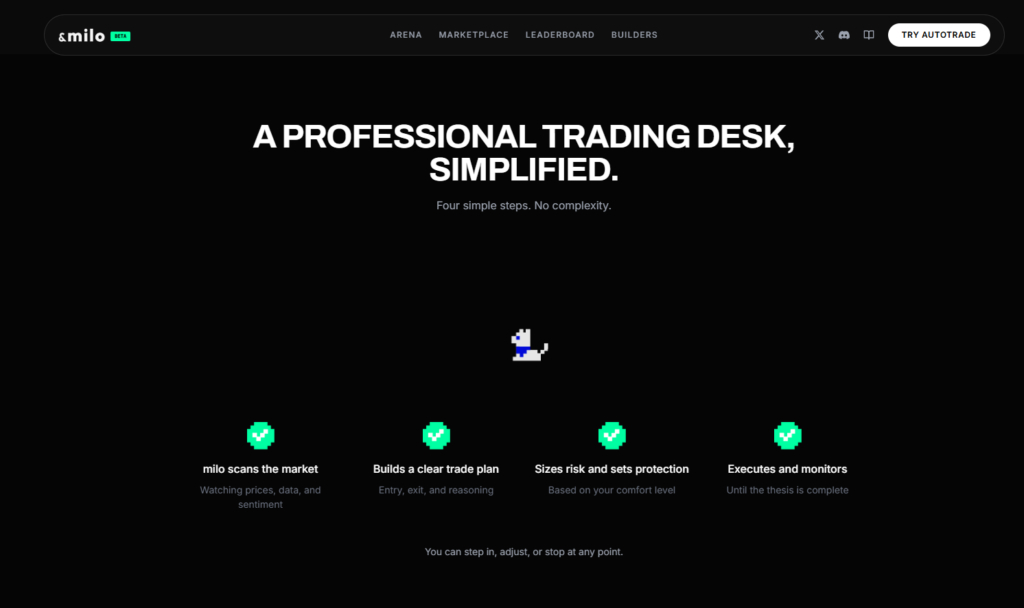
AutoTrade is where Milo moves from advisor to executor, which helps the users automate the process. Users set their risk tolerance and asset preferences. Milo watches the market continuously, filters noise, identifies setups that match the thesis, enters positions when conditions are right, monitors them actively, adjusts when the original thesis breaks, and exits accordingly. Some users run AutoTrade fully hands-off. Others co-pilot alongside Milo, asking questions, pushing back on ideas, or requesting custom strategies. Both approaches are supported, and the system adapts naturally to either.
Portfolio Command Center
The Command Center gives users a full view of every position, every wallet, every chain, and the overall risk profile of the portfolio at a glance. Milo surfaces optimisation opportunities proactively. If three liquidity pool positions are underperforming while better yield options exist nearby, Milo flags it. If SOL exposure has drifted above target allocation with a volatility event approaching, Milo surfaces a protection strategy before the problem arrives.
Non-Custodial Architecture
This is one of Milo’s most important structural decisions, and it became especially visible during the Drift Protocol exploit in April 2026, when $285 million was drained from a custodial DeFi protocol on Solana. Milo users were unaffected. Milo never holds funds. When AutoTrade executes, it sends a signed instruction to the user’s own wallet. The user’s keys never leave the user’s control. A protocol being compromised elsewhere does not touch assets managed through Milo.
Agent-to-Agent API
For developers and power users, Milo exposes a full API that allows external agents, including Claude, OpenAI-based agents, and custom builds to plug into Milo’s portfolio management infrastructure. The skill file in the partners section contains the full API reference and endpoint specs. This makes Milo one of the few retail-accessible AI trading systems that is genuinely designed to operate inside broader agentic workflows.
What Milo Is Not
Milo is Solana-only. Traders with significant positions on Ethereum, Base, or other L1s will not find native coverage for those assets yet. The platform is also best suited for traders who are comfortable with DeFi concepts, Solana wallets, and the mechanics of on-chain execution. Complete beginners to crypto will find the learning process steeper than the platform’s plain-English communication style might suggest.
Milo also carries the inherent risks of any AI-driven trading system. Past performance does not guarantee future results, and autonomous execution in a market as volatile as Solana carries real risk regardless of how disciplined the underlying reasoning engine is.
Who Should Use Milo
Milo is well-suited for three types of Solana traders. First, active traders who have conviction in the Solana ecosystem but lack the infrastructure, time, or analytical depth to monitor markets continuously. Second, DeFi participants who want their stablecoin and LP positions optimised without manually tracking protocol yields across a dozen dashboards. Third, developers and AI builders who want to plug a battle-tested portfolio management layer into their own agentic systems through the API.
Conclusion
Milo is not a signal bot dressed up with a better interface. It is a genuinely different approach to crypto portfolio management: one that reads three layers of market data simultaneously, reasons through them the way a disciplined professional would, and explains every decision before and after it is made. For Solana traders who want structure, transparency, and autonomous execution without giving up custody of their funds, Milo is one of the most thoughtfully built tools in the ecosystem right now. It is not for everyone, and it is not trying to be. But for the trader it is designed for, the value is clear.
Frequently Asked Questions (FAQs)
Is Milo safe to use with real funds?
Milo is non-custodial, meaning your funds never leave your wallet. Milo sends signed trade instructions to your wallet for execution. Even if Milo’s systems experienced issues, your assets remain in your own custody and are not exposed to platform-level risk.
Does Milo work on blockchains other than Solana?
Currently no. Milo is built specifically around the Solana ecosystem, reading Solana RPC data, Birdeye market feeds, and Cookie3 social sentiment. Traders with significant holdings on Ethereum or other chains will need separate tools for those assets.
Can I control how aggressively Milo trades?
Yes. Before AutoTrade activates, users define their risk tolerance, asset allow list, and allocation weights. Milo operates strictly within those parameters. Strategies can be rotated and updated without changing any underlying code or agent configuration.
How is Milo different from a copy trading bot or signal service?
Milo generates original theses by reasoning across on-chain data, market structure, and social sentiment simultaneously. It explains every decision in plain English. A signal bot fires alerts. Milo builds a case, executes on it, monitors it, and closes it when the logic no longer holds.
Do I need coding knowledge to use Milo?
No. The standard platform requires no technical knowledge. The agent-to-agent API and CLI tools are available for developers who want to integrate Milo into broader automated workflows, but the core product is accessible to anyone comfortable with a Solana wallet.