



In the rapidly evolving landscape of crypto trading and on-chain analytics, platforms differentiate themselves through speed, automation, user experience, and strategic focus. Tools such as Mevx, Sigma, Fomo, and Bloom each aim to address trader pain points, but they do so with distinct philosophies and feature priorities.
Mevx vs Sigma vs Fomo vs Bloom: Overview
| Platform | Main Type | Main Interface | Main Focus | Primary Chain Focus |
|---|---|---|---|---|
| Mevx | Advanced trading & execution tool | Trading dashboard / terminal-style UI | Speed, automation, low-latency execution | Primarily EVM chains (commonly Ethereum & major L2s) |
| Sigma | Analytics & decision-support platform | Data-driven dashboards with indicators | Market analysis, structured insights, strategy support | EVM chains with emphasis on Ethereum data |
| Fomo | Momentum & sentiment-based trading platform | Trend feeds and signal-oriented interface | Hype detection, social momentum, early opportunities | Often multi-chain, with strong presence on fast, speculative chains |
| Bloom | User-friendly trading & automation platform | Clean, simplified UI | Accessibility, ease of use, guided trading | Typically EVM-focused, sometimes expanding to multiple chains |
Mevx

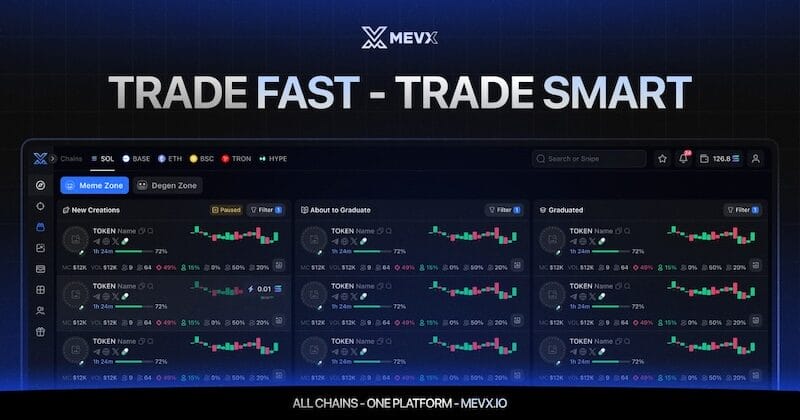
Mevx positions itself as a performance-driven trading platform, emphasizing execution speed and efficiency. Its primary appeal lies in serving active traders who prioritize rapid response to market movements, particularly in volatile or early-stage token environments. Mevx typically focuses on automation, streamlined workflows, and low-latency execution, making it attractive to users who value precision over extensive visual analytics. The platform tends to favor function over form, catering more to experienced traders than to newcomers.
Key Points
- MevX is a memecoin trading and sniper platform.
- It focuses on fast execution and automation.
- The platform supports advanced presets and multi-wallet trading.
- MevX is optimized for high-volatility tokens.
- MevX launched in May 2024.
- It is primarily focused on Solana with expanding multi-chain support.
Sigma

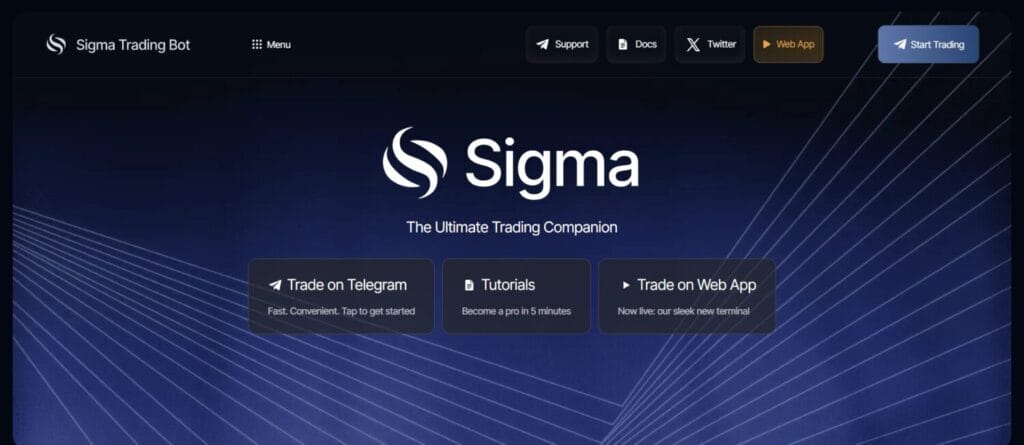
Sigma is a multi-chain trading and sniping bot built around Telegram, with an accompanying web portal for configuration and monitoring. It focuses on fast execution, sniping, and broad chain coverage, while providing standard features such as scam protection, trading controls, and copy-trading functionality. Compared to fully Telegram-native tools, Sigma is better suited for traders who value chat-based speed but also want a web interface for managing multiple wallets, settings, and overall oversight more efficiently.
Key Points
- Sigma is a Solana-based meme token project.
- It is community-driven with no presale.
- The project emphasizes decentralized culture.
- Sigma launched in July 2024.
- It trades mainly on Solana DEXs and exchanges.
- Sigma does not operate as a full trading platform.
Also, you may read Top 10 Solana APIs for Trading
Fomo

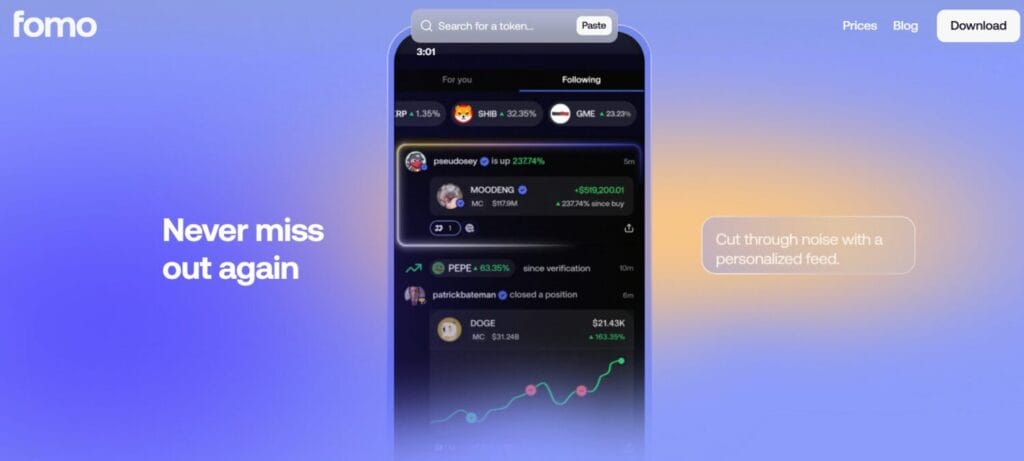
Fomo is designed around market sentiment and momentum, targeting users who thrive on hype cycles, trending assets, and social-driven price action. The platform’s strength lies in surfacing opportunities tied to attention, virality, and rapid inflows of liquidity. While this can unlock high-upside trades, it also implies higher risk. Fomo tends to attract speculative traders who are comfortable operating in fast-moving environments where timing and crowd behavior matter as much as fundamentals.


Key Points
- Fomo is a cross-chain crypto trading application.
- It focuses on social and momentum-based trading.
- Users trade with a single unified balance.
- The platform reduces wallet and gas complexity.
- Fomo launched publicly in May 2025.
- It supports multiple major blockchains.
Also, you may read 7 Best Solana Wallets for Meme Coins
Bloom

Bloom Bot is a Telegram-based crypto trading automation tool, with an optional browser extension, that lets users trade tokens on Solana and EVM-compatible chains without a separate, complex app. It simplifies buying and selling for both beginners and experienced traders by automating trades, enabling fast sniping of new token launches, and offering features such as limit orders, auto-sell rules, copy trading, and portfolio tracking.
Key Points
- Telegram-based, non-custodial trading bot with no separate apps required.
- Launched in 2024 with a rapidly growing user base and reported lifetime volume.
- Focused on spot trading, especially Solana tokens and memecoins.
- Offers sniping, quick buy/sell, limit orders, and a fast “degen mode”.
- Supports controlled entry and exit through limit orders, not just market trades.
- Charges transaction fees on trades, with potential referral-based discounts.
Mevx vs Sigma vs Fomo vs Bloom: Fees Structure
MEVX
- MevX promotes very low or zero trading fees on certain chains as a competitive feature.
- The platform emphasizes low transaction cost execution, especially on Solana-based trades.
- Specific fee details vary by network and promotion, with occasional 0% fee events on new chains.
- Users may still incur underlying blockchain gas fees when interacting with on-chain DEX liquidity.
Sigma
- Standard bot fee is 1% per trade, including sniping and regular transactions, across most supported chains such as Ethereum, Avalanche, BSC, and Base.
- On Solana, the bot fee may be 0%, with only network fees required.
- Fees are charged on a per-transaction basis and are consistent across supported EVM chains.
Fomo
- Fomo charges a flat 0.5 % transaction fee on every buy and sell trade.
- On Solana, the minimum fee is approximately $0.95 per transaction.
- On some lower-cost chains (e.g., Base or BNB Chain), there may be no minimum fee requirement.
- Fomo waives blockchain gas fees for the user.
Bloom
- Bloom charges a 1 % fee on each buy and sell trade on its platform.
- Users who sign up through a referral link receive a 10 % discount, reducing the fee to 0.9 %.
- The fee covers platform operation, infrastructure, and feature support.
Mevx vs Sigma vs Fomo vs Bloom: Security Information
| Platform | Custody Model | User Key Control | Security Transparency | Overall Security Summary |
|---|---|---|---|---|
| MevX | Non-custodial | Users control wallets and private keys | Limited public security documentation | Relies on on-chain execution and user self-custody |
| Sigma | Token-only (no platform custody) | Users control Solana wallets | Minimal disclosures beyond token details | Security depends on Solana network and token contract |
| Fomo | Non-custodial trading app | Users retain asset control | App-level privacy and security disclosures available | Uses encrypted infrastructure and on-chain trades |
| Bloom | Non-custodial / privacy-focused | Users control credentials and wallets | Public emphasis on encryption and privacy design | Focuses on user-controlled data and privacy-first architecture |
Conclusion
Although Mevx, Sigma, Fomo, and Bloom exist in the same trading ecosystem, each targets a different type of trader. Mevx is built for speed-driven professionals, Sigma appeals to data-focused strategists, Fomo suits momentum and sentiment traders, and Bloom emphasizes ease of use and accessibility. Recognizing these distinctions is essential to choosing a platform that matches your trading style, risk appetite, and experience level.
Frequently asked questions (FAQs)
Which platform is best for beginners?
Bloom is generally the most beginner-friendly due to its intuitive interface and simplified workflows.
Which platform focuses most on speed and execution?
Mevx emphasizes fast execution and efficiency, making it suitable for active and professional traders.
Which platform is best for data and analytics?
Sigma is best suited for traders who rely on structured analytics, indicators, and data-driven decision-making.
Which platform targets hype and momentum trading?
Fomo focuses on sentiment, trends, and fast-moving market opportunities driven by crowd behavior.


