

Affiliate Disclosure: This Ledger Nano S Plus review contains affiliate links. If you buy through them, CoinCodeCap may earn a commission at no extra cost to you. We bought the device with our own money, and Ledger had no input on the copy below.
How We Review Hardware Wallets: We pull specs and pricing from the manufacturer’s own storefront, then check them against dated, independently reported security incidents tied to the specific model, not just the brand. Here that means Ledger’s own product page plus two 2026 stories: April’s counterfeit-device scandal and August’s Ethereum app disclosure dispute.
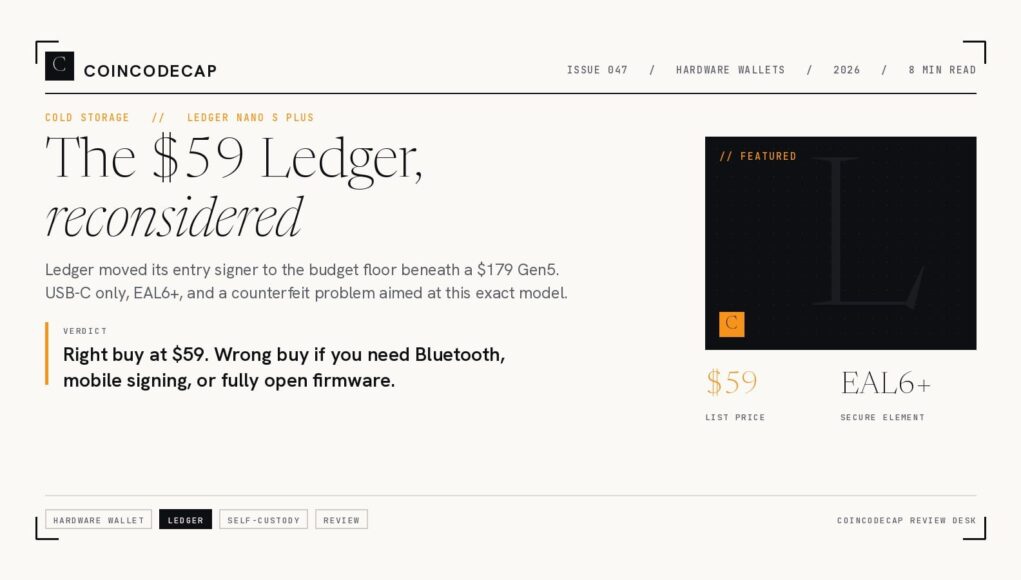
TL;DR: The Ledger Nano S Plus costs $59 and runs on a Common Criteria EAL6+ secure element (ST33K1M5). It connects over USB-C only, with no Bluetooth, no NFC, and no battery. It now sits at the bottom of Ledger’s price ladder, below the Nano X, Nano Gen5, Flex, and Stax, but it runs the same Ledger Wallet app as all of them. Buy only from ledger.com after April 2026’s counterfeit-device scandal, and if fully open hardware matters to you, the Trezor Safe 3 costs the same $59 with nothing closed off.
Ledger Nano S Plus Review: The $59 Floor Beneath Ledger’s New Lineup
Ledger doesn’t put this number front and center, but $59 is the one that matters, confirmed straight from shop.ledger.com’s own product data as of late August 2026. If you’re seeing $79 anywhere, that listing is stale.
The Nano S Plus is Ledger’s entry-level hardware wallet, the direct successor to the original Nano S that Ledger retired between 2016 and 2022 after its CTO cited memory limits as the reason software support ended. It still sells in close to ten color variants, from Matte Black to Bonk, and ships bundled into Ledger’s Backup Pack, Family Pack, and OTG Kit. None of that changes what it is underneath: a small USB stick that signs transactions and keeps your private keys off the internet.

Where It Sits in Ledger’s 2026 Lineup
Ledger quietly turned the Nano S Plus into a budget floor. The current ladder runs $59 for the S Plus, $149 for the Nano X, $179 for the new Nano Gen5, $249 for the Flex, and $399 for the Stax. Every tier above the S Plus adds either Bluetooth, a bigger touchscreen, or both.
The Nano Gen5 is the newest piece of that ladder. Ledger unveiled it on October 23, 2025, at its “Op3n” event in Paris, with a 2.8-inch E Ink touchscreen plus Bluetooth and NFC. At the same event, Ledger rebranded its hardware line as “Ledger Signers” and renamed Ledger Live to “Ledger Wallet,” so you’ll see both names used for a while yet.
For buyers, the Nano S Plus hasn’t been Ledger’s flagship for a while. It’s the cheap, no-frills option Ledger keeps around for people who just want cold storage without a touchscreen or wireless signing. See our Ledger Wallet explainer for how the app and the signer work together.
Specs: What’s Actually Inside
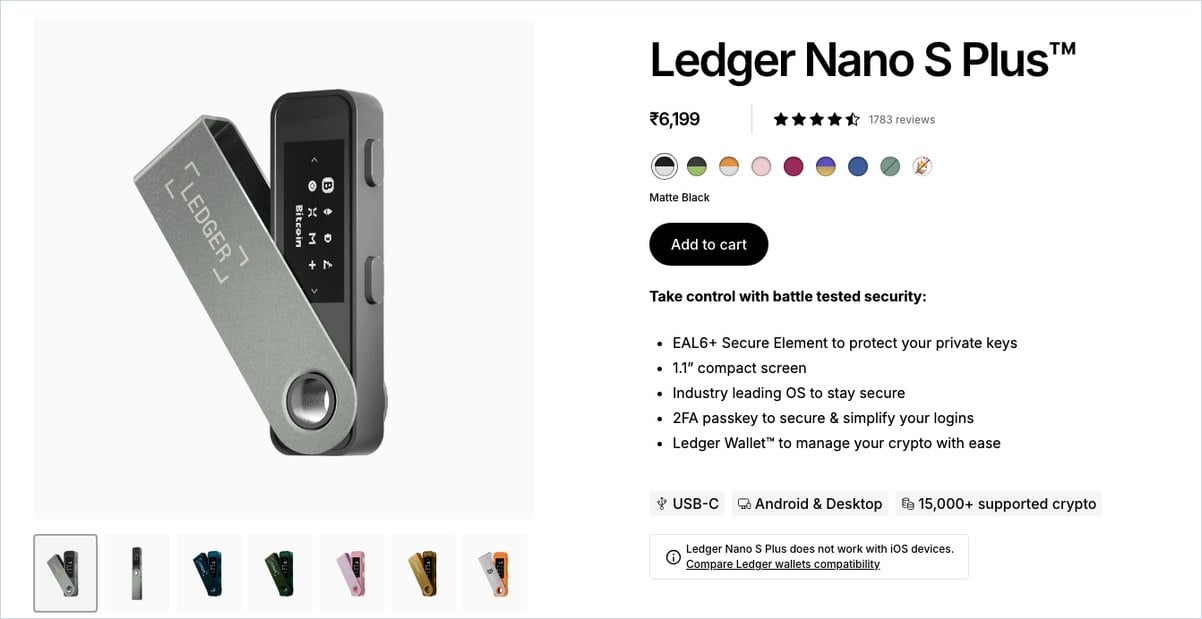
The Nano S Plus runs on an ST33K1M5 secure element, certified to Common Criteria EAL6+. That’s the same certification tier as the Trezor Safe 3 and Safe 5 and the BitBox02, though certification level alone doesn’t tell the whole security story.
- Monochrome OLED screen, 128×64 pixels, 1.1 inches
- USB-C only. No Bluetooth, no NFC, no battery. It draws power from whatever it’s plugged into
- Dimensions of 62.4 x 17.4 x 8.2 mm, weighing 21 grams
- Holds up to 100 apps installed at once
- Backed by a 1-year limited manufacturer warranty
The connectivity line is what shoppers confuse most. The S Plus and the Nano X look nearly identical in photos, but only the Nano X adds Bluetooth for mobile signing. The S Plus can’t approve transactions from your phone without a cable, and it skips NFC entirely, which rules out the tap-to-sign flow Tangem and some card wallets use.
How Many Crypto Assets It Actually Supports
Ledger’s own product page says the Nano S Plus can “securely manage 15,000+ crypto.” Elsewhere on Ledger’s site you’ll find “500+ natively in the app” and “5,500+ tokens.” Those aren’t contradictory, just three ways of counting the same thing: native chains versus supported tokens versus everything reachable through third-party integrations. Don’t anchor on the 15,000 headline; check the Ledger Wallet app’s asset list for your exact coin before you buy.
Is the Ledger Nano S Plus Open Source?
Partly. Ledger Wallet’s app code runs under an MIT license and is published openly, along with the Wallet API, the Secure SDK (including its crypto library), embedded apps, and the OS command dispatcher. That’s a genuinely large chunk of the stack.
What stays closed is the secure element’s low-level firmware. Ledger says its agreement with chipmaker STMicroelectronics legally blocks it from publishing that code, so BOLOS, the device’s operating system, is only partially reviewable. Trezor, Coldcard, and BitBox02 all publish their full hardware and firmware for independent audit. If fully open, nothing-hidden design is a requirement rather than a preference, the Nano S Plus doesn’t clear that bar.
Ledger’s Security Track Record: 5 Incidents Worth Knowing
None of this means anyone pulled keys off a genuine Nano S Plus remotely, but Ledger, the company, has a real history worth reading before you trust it with your seed phrase.
- July 2020: A misconfigured API key, live since August 2018, let attackers scrape Ledger’s e-commerce database between April and June 2020. About 1.1 million email addresses leaked, plus roughly 272,000 records with full names, phone numbers, and home addresses. No funds or keys were touched, but the leak still fuels phishing against Ledger owners today.
- May 2023: Ledger announced a feature called Recover. The announcement itself became the controversy: it revealed the firmware could technically export encrypted seed fragments with on-device consent, cutting against years of “your keys never leave the device” marketing. Ledger paused the rollout after backlash.
- October 2023: Ledger Recover shipped as a strictly opt-in, $9.99-a-month service requiring ID verification, splitting your encrypted seed across three custodians. It’s still opt-in and still live in 2026.
- December 2023: An attacker phished a former developer’s un-revoked npm key and pushed malicious versions of the Ledger Connect Kit library, live for roughly four hours. At least $600,000 to $700,000 was stolen from dapp users before Ledger shipped a clean version and Tether froze the attacker’s USDT.
- January 2026: Ledger disclosed a breach at Global-e, a third-party payment partner, exposing customer names, emails, addresses, and order details. No payment data or recovery phrases were involved, and Ledger hasn’t disclosed how many customers were affected.
The April 2026 Counterfeit Nano S Plus Scandal
This is the story specific to the exact device this review covers, and it’s the strongest reason to be careful about where you buy one. On April 17, 2026, a Brazilian security researcher exposed counterfeit Nano S Plus units sold through a Chinese marketplace.
The fakes had their genuine secure element physically swapped for an ESP32-S3 chip, markings scraped off, plus a WiFi and Bluetooth antenna no real Nano S Plus carries. A QR code inside the box pointed buyers to a cloned site serving a trojanized “Ledger Live” app with a hardcoded fake Genuine Check, so the counterfeit would pass the one test a cautious buyer might think to run.
Confirmed losses reached over $9.5 million across more than 50 documented victims, spanning roughly 20 blockchains. Ledger tells buyers to purchase only from ledger.com or an Authorised Reseller, and to run the Genuine Check from the Ledger Wallet app downloaded directly from ledger.com, never from a link or QR code the seller provides.
The August 2026 Ethereum App Dispute
Between August 12 and August 24, 2026, a race-condition flaw surfaced in Ledger’s Ethereum app, the software module shared across the Nano X, Nano S Plus, Stax, Apex, and Flex. In theory, a malicious app could swap a legitimate transaction for a harmful one while it sat on screen waiting for approval.
Ledger’s own Donjon security team patched the issue on August 12 in Ethereum app version 1.22.2. Security firm TestMachine then publicly disclosed the flaw on August 21 and 23 through its AI agent, Azimuth, which read as a fresh discovery to anyone not tracking Ledger’s changelog. Ledger CTO Charles Guillemet pushed back on that framing on August 24, noting the fix had already shipped two weeks earlier, and no confirmed fund losses had been reported as of that date. Whatever the disclosure timeline, the outcome for owners is the same. Keep the Ledger Wallet app and installed apps current, since a patched device closes the gap and an unpatched one doesn’t.
Who Should Skip the Nano S Plus
Skip it if you want to approve transactions from your phone without a cable. No Bluetooth means no mobile-first signing, a workflow some buyers rely on daily. Ledger’s own product page goes further and states that the Nano S Plus does not work with iOS devices at all, which should settle it for iPhone owners. The Nano X, Nano Gen5, Flex, and Stax all cover that gap; the S Plus doesn’t.
Certification level is another reason to look past it. EAL6+ is solid, but it isn’t the ceiling: the NGRAVE ZERO carries EAL7, the highest commercial rating, and our Ledger vs NGRAVE ZERO comparison covers what that gap buys in practice.
Recover is worth weighing on its own. If you’re not comfortable with your seed being splittable across three custodians under any circumstances, skip the device or leave Recover switched off. Recover is opt-in and encrypted, but that sharded-custody model asks for a trust some buyers will correctly refuse, however well it’s built.
Bitcoin-only buyers have their own reason to pass. A Coldcard or a Blockstream Jade goes deeper on air-gapped, BTC-native workflows than a multi-chain generalist ever will.
Ledger Nano S Plus vs 9 Other Cold Wallets
The table below lines up the $59 price point against nine other cold wallets on secure elements, open-source status, and connectivity.
✅ What Works
- $59 undercuts the Nano Gen5, Flex, and Stax while running the same Ledger Wallet software
- ST33K1M5 secure element certified EAL6+, matching the standard set by Trezor Safe 3, Safe 5, and BitBox02
- Ledger Wallet’s app code and Secure SDK are published under MIT, so the software layer is auditable
- USB-C only means one cable, no Bluetooth radio, and no battery to degrade over time
- Handles up to 100 installed apps and a broad range of assets
❌ Trade-offs
- No Bluetooth or NFC, and Ledger says it doesn’t work with iOS devices at all, so no mobile-first signing the way the Nano X, Nano Gen5, Flex, or Stax offer it
- The secure element’s low-level firmware stays closed; Ledger cites its agreement with STMicroelectronics as the reason
- Ledger Recover, even opt-in, splits your seed across three custodians for $9.99 a month, a trust model that isn’t for everyone
- Certified EAL6+, not EAL7. NGRAVE ZERO carries the higher rating if certification level decides your purchase
- A verified counterfeit-device scandal in April 2026 makes buying outside ledger.com or an authorized reseller a real risk on this model
Expert Tip: Before you fund a new Nano S Plus, run the Genuine Check inside the Ledger Wallet app you downloaded yourself from ledger.com, not from any link, QR code, or install file that shipped in the box. Given the April 2026 counterfeit run, that single step is the difference between owning a real secure element and owning an ESP32 chip dressed up to look like one.
How much does the Ledger Nano S Plus cost?
$59 USD, confirmed directly from shop.ledger.com’s product data. European buyers see €49 including VAT. Any listing still showing $79 is outdated.
Does the Ledger Nano S Plus have Bluetooth?
No. It connects over USB-C only, with no Bluetooth, no NFC, and no battery. The Nano X, Nano Gen5, and Flex add wireless signing; the S Plus doesn’t.
Is the Ledger Nano S Plus fully open source?
Partly. The Ledger Wallet app, Wallet API, and Secure SDK are published under MIT. The secure element’s low-level firmware stays closed, which Ledger attributes to its agreement with chipmaker STMicroelectronics.
What happened with the counterfeit Ledger Nano S Plus units?
In April 2026, a researcher exposed fake Nano S Plus devices sold through a Chinese marketplace with the secure element swapped for an ESP32-S3 chip and a fake Genuine Check built into a cloned app. Confirmed losses topped $9.5 million across 50-plus victims. Buy only from ledger.com or an Authorised Reseller.
Should I worry about the August 2026 Ethereum app vulnerability?
Ledger’s Donjon team patched the race-condition flaw on August 12, 2026, before public disclosure went out on August 21 and 23. No confirmed fund losses had been reported as of August 24, 2026. Keep your apps updated to stay covered.
Ledger Nano S Plus vs Trezor Safe 3: which should I buy?
Both cost $59 with an EAL6+ secure element, so price and certification are a wash. Trezor Safe 3 publishes its full hardware and firmware; the Nano S Plus keeps its secure element firmware closed. Pick Trezor for full openness, Ledger for the larger app ecosystem.
Bottom Line: The Ledger Nano S Plus is a solid, cheap, no-frills signer at $59, and it earns its spot as the entry point beneath Ledger’s newer, pricier hardware. It isn’t the automatic winner, though. The Trezor Safe 3 matches it on price and certification while publishing its entire stack, and buyers chasing higher certification, full openness, or Bitcoin-only air-gapped hardware are better served elsewhere on this page. Buy it for Ledger’s ecosystem at the lowest price, buy it only from ledger.com, and run the Genuine Check before you fund it.
Editorial note: every price, spec, and date here was checked against Ledger’s own product pages and dated, independently reported security disclosures as of August 29, 2026. Pricing and advisories change; verify current details directly with Ledger before you buy.
Related Reading
Compare Ledger’s Own Lineup
Fully Open-Source Alternatives
More Ways to Store and Spend Crypto
Head-to-Head Wallet Comparisons