

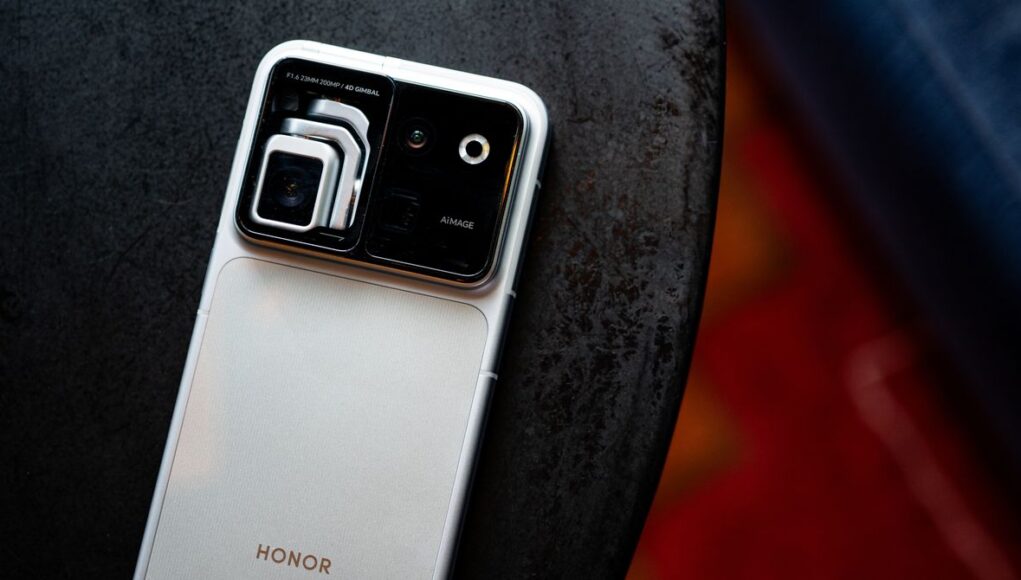
The gimbal-powered 200-megapixel camera isn’t the only camera, either. It’s joined by a 200-megapixel telephoto camera and a 50-megapixel ultrawide, not to mention the 50-megapixel selfie shooter. The gimbal has 4 degrees of freedom, and you can activate it in the camera app or by making a palm motion on the selfie camera. And since it can rotate 300 degrees, you can use it as a selfie camera too.
The phone is shockingly light at 248 grams (the aforementioned iPhone 17 Pro is 206 grams). I wholly expected the Robot Phone to be top-heavy, with all those camera components at the top and the massive 7,060-mAh silicon-carbon battery inside powering the whole system. But in fact it’s decently balanced.
A glass cover protects the gimbal camera, and you can slide it to the right when you’re ready to activate the gimbal. Once the camera is out, you can manually control the gimbal for ultra-smooth video capture through the camera app, or use preset motions to give your clips a cinematic look. There’s even voice control with natural language, so you can say “turn around for 5 seconds.”
The motorized stabilization in the camera makes action shots—which can typically look shaky on traditional smartphones—look amazingly smooth. There are tracking modes as well, such as a subject tracker that keeps the selected person in the frame even as they move around. You can imagine how helpful that can be for solo travelers vlogging their way through a trip.
Some of these features extend past content creation. For example, the subject-tracking mode works in video calls, meaning you can set the phone up on a table (Honor includes a case and a magnetic stand) and the camera can follow you around. I also took a group selfie, and instead of taking a normal picture, the gimbal took three photos—left, center, and right—and stitched them like a panorama for a wide shot of everyone. Quick and seamless.
There’s a less effective and quite gimmicky integration with Honor’s Yoyo virtual AI assistant, where the gimbal camera acts like an enigmatic robot with a pair of eyes on the phone’s screen. Ask it to dance to music, and the gimbal camera will move to the beat. It can pretend to be happy or angry, making the appropriate movements to indicate its mood. The camera also serves as the AI’s eyes; ask it to describe the scene in front of you, and it’ll take a peek.
.jpg)