

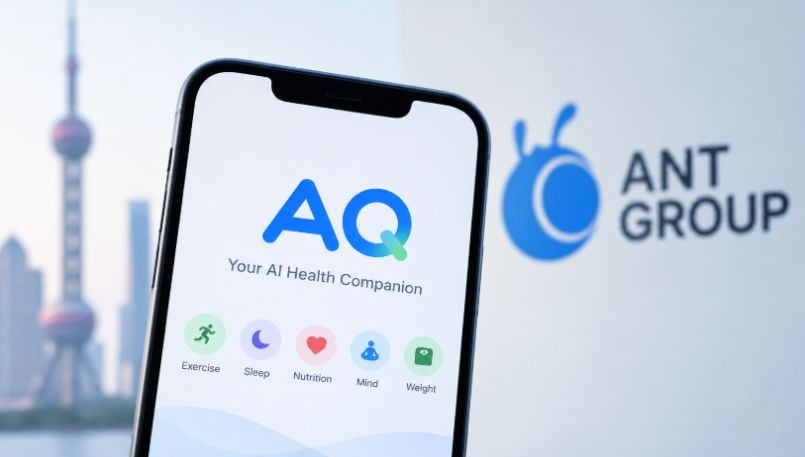
Ant Group’s AQ health app has reached 150 million users as the company pushes the platform beyond doctor bookings and medical consultations into everyday health tracking.
Zhang Junjie, vice president of Ant Group and head of its health business, announced the milestone at the 2026 INCLUSION · Conference on the Bund in Shanghai. AQ is also handling nearly 20 million health-related inquiries each day, according to Ant Group.
The latest figure marks a sharp increase from the 100 million users Ant Group reported in February. Launched in June 2025, AQ initially focused on AI-enabled services such as doctor recommendations, hospital appointment booking and online consultations.
From medical help to daily health
Ant Group is now positioning AQ as a broader health companion, with the platform expanding into five areas: weight, exercise, nutrition, sleep and mental wellbeing.
A new Health section on AQ’s homepage will bring these services together. Users will be able to connect smartwatches, fitness bands and other health devices, while also tracking their daily diet.
AQ can analyze more than 10 health indicators, including weight and sleep, and use that information to provide assessments, personalized analysis and recommendations. It can also draw on previous interactions to send follow-up reminders when it detects changes in a user’s habits.
“People often know what they should do to manage their health, but find it difficult to put that knowledge into practice,” Zhang said. The company has introduced features including AI Food Scan for calorie management, AI Vitality Management and an AI weight management coach.
More must-read AI coverage
Why Ant Group is pushing deeper into health
The expansion comes as health becomes a stronger priority for Chinese consumers. Accenture’s China Consumer Insights report, published in November 2025, found that 87% of Chinese consumers considered health a priority in 2025, up from 78% in 2021.
Ant Group is also testing whether AI-driven coaching can translate into measurable behavior changes. Its nationwide weight management initiative, launched in June, has attracted 2.75 million participants who have collectively lost more than 2.5 million kilograms as of September, according to the company.
The scale of AQ’s user base gives Ant Group a large audience for turning health data and AI recommendations into recurring services. But that also makes the quality of its recommendations, handling of personal health data and involvement of professional partners increasingly important as AQ takes on more health-management tasks.
“Health management requires collaboration across the ecosystem and a long-term commitment,” Zhang said, according to Ant Group.
Ant Group plans to expand AQ through partnerships spanning smart hardware, healthy food, sports, and nutrition, pushing the app further into users’ daily routines.
That could make AQ less about answering individual health questions and more about continuously interpreting user data and recommending what to do next.
The more central that role becomes, the more the platform’s credibility will depend on the accuracy of those recommendations, the involvement of qualified health professionals, and how transparently Ant Group handles the personal data powering them.
More digital health news: Apple is redesigning its Health app to turn wearable data into personalized daily guidance, including readiness scores and Health Age estimates, as it shifts from passive tracking toward AI-powered wellness coaching.