
In Bitcoin ETF news today, Tuesday, May 26, someone sold 29 million shares of BlackRock’s iShares Bitcoin Trust in a single transaction worth approximately $1.29Bn, the largest block trade in IBIT’s fifteen-month history. Since then, Bitcoin has dropped nearly -5% before stabilizing between $73,000 and $74,000.
Here is the central tension this article unpacks: if a $1.3Bn sale of a Bitcoin ETF can’t crash Bitcoin, what does that tell you about where the market actually stands right now?
“This dwarfs all other trades for the day and perhaps ever”, said Alex Thorn of Galaxy Digital, commenting on the IBIT sale via X on May 26, 2026. Bitcoin’s price was essentially unchanged on the day.
Thorn’s framing matters. The analyst wasn’t flagging danger; he was flagging something much more significant: proof that Bitcoin’s institutional market infrastructure has grown deep enough to absorb shocks that would have caused a 20–30% wipeout in a previous cycle.
$BTC is showing slight recovery here.
The key level here is $74,500 which needs to be reclaimed for any strong rally.
If Bitcoin fails to reclaim this zone, the next target would be $70,000. pic.twitter.com/d1iI658q2o
— Ted (@TedPillows) May 29, 2026
Bitcoin ETF News: What the $1.3 Billion Number Actually Tells You
A dark pool may sound ominous, but it functions like a private auction room for institutional trading, executed off-exchange to avoid affecting public prices. Recently, a $1.29Bn block trade in Bitcoin occurred before market open, preventing a potential market crash that could have occurred with a direct market sell.
This trade’s discretion was crucial: had it hit the public order book, it could have triggered stop-losses and liquidations, leading to a chaotic price drop. Instead, the existing market depth absorbed the trade without dislocation, indicating market maturity rather than crisis.
BlackRock’s IBIT ETF, now over $50Bn in assets, illustrates this institutional activity. The seller’s identity remains unknown, with speculation ranging from a hedge fund to a sovereign wealth fund or a family office, all suggesting a sophisticated strategy to exit quietly without triggering panic.
DISCOVER: The Next 1000x Crypto Gem Before It Lists on Binance
Can Bitcoin Reclaim $80,000 After the BlackRock IBIT Shock?
Bitcoin’s price was under pressure ahead of the recent event, dropping from around $82,500 on May 6, 2026, to $73,200 by May 28. The 50-day EMA acts as immediate support at $73,150, while the 200-day EMA at $78,500 serves as resistance.
The $73,000–$73,500 zone is crucial, with Swissblock data indicating that a drop below this level could trigger a decline toward $70,500, near the previous support at $70,740 from April 12, 2026.
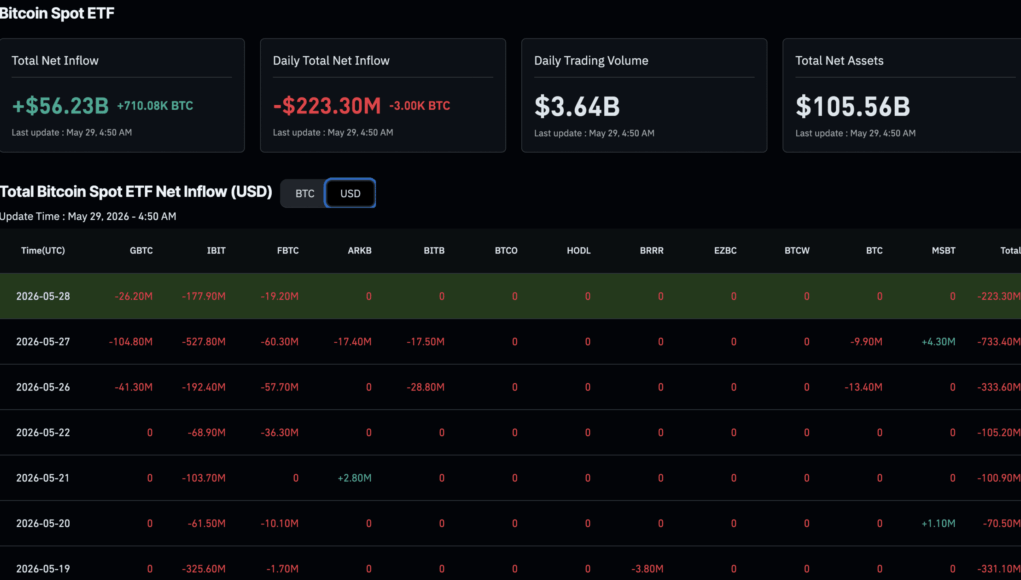
Additionally, BTC spot ETFs faced significant outflows, with $1.039Bn leaving for the week of May 11–15, ending a six-week inflow streak. Since May 14, $2.26Bn has exited US spot Bitcoin ETFs, and net accumulation for 2026 has dropped to just 4,500 BTC, wiping out much of the previous buying momentum.
- Bull case: Bitcoin holds $73,000 through the week’s close. ETF flow data stabilizes and reverses. The dark pool trade is absorbed as a one-off rebalancing event, and BTC USD begins rebuilding toward the $80,000 level. Cumulative institutional demand remains structurally intact.
- Base case: Bitcoin consolidates in the $73,000–$75,000 range for one to two weeks while the market digests overlapping pressures, ETF outflows, post-CLARITY Act regulatory uncertainty, and broader macro positioning. No clean directional break in either direction.
- Bear case: A decisive close below $73,000 triggers a liquidation cascade toward the mid-$60,000s. Leveraged longs, already crowded, as evidenced by the $700M in long liquidations on May 28 alone, amplify the move lower. The Fear and Greed Index, already sitting at 25/100, drops further into extreme fear territory.
Are ETF Flows Key to Future Crypto Price Action?
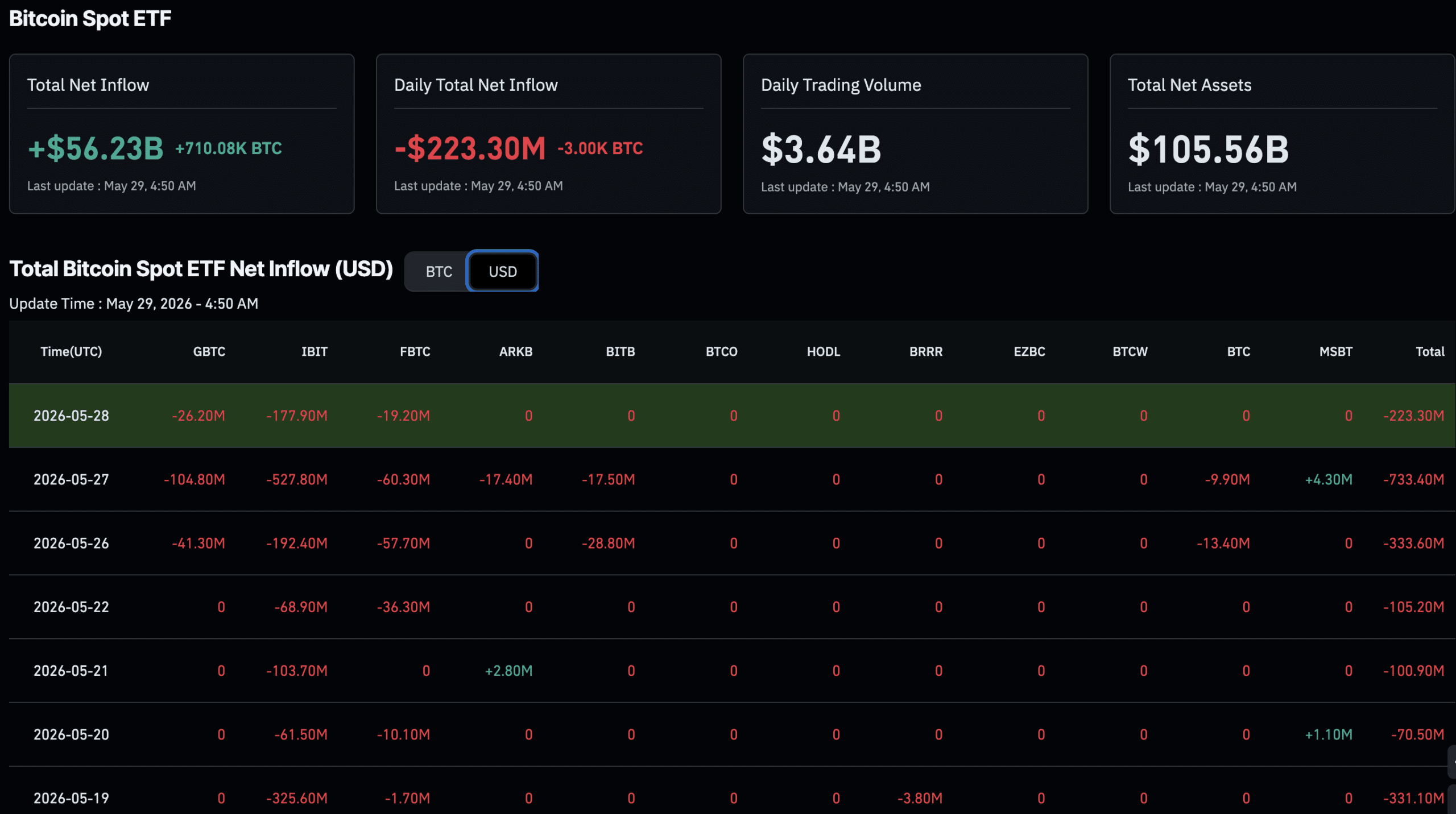
In other Bitcoin ETF news, watch the weekly ETF flow data from CoinGlass and SoSoValue as your primary forward signal. Those numbers will confirm or contradict whatever the price chart appears to be saying.
One additional data point worth keeping in perspective: despite the current outflow streak, BlackRock’s revenues from its Bitcoin ETF now exceed those generated by some of its flagship equity index funds.
The firm has also filed for an iShares Bitcoin Premium Income ETF, seeking to layer yield strategies onto BTC holdings. BlackRock is not retreating from Bitcoin. It is building a deeper product stack around it – which changes how you should read short-term flow data.
To analyze Bitcoin through ETF flow data alone, what analysts at Swissblock and elsewhere call the core methodology for analyzing Bitcoin in the institutional era, is to track the most transparent signal of large-money conviction. Right now, that signal says caution. It does not say exit.
DISCOVER: Best Meme Coin ICOs to Invest in 2026
The post Bitcoin ETF News: BlackRock’s $1.3Bn IBIT Dark Pool Sale – Why Didn’t BTC Crash? appeared first on 99Bitcoins.