

Key Takeaways:
- Polymarket pulled a bet on a missing U.S. airman’s rescue on April 3, 2026, after Rep. Seth Moulton called it “disgusting.”
- More than 63% of bettors wagered against a quick rescue confirmation, drawing sharp criticism from lawmakers and veterans.
- The second F-15E crew member was safely recovered by April 4-5, 2026, intensifying calls for federal oversight of prediction markets.
Polymarket War Bets Under Fire After U.S. Airman Rescue Market Goes Viral
The incident unfolded during the ongoing conflict involving U.S. and Israeli strikes on Iran. An F-15E Strike Eagle was shot down over Iranian territory on or around April 3. Both crew members ejected. U.S. forces quickly located and recovered one airman. The second, a weapons systems officer, remained missing while a search-and-rescue operation was still active inside Iran. By Sunday, April 5, the second airman was rescued in southwestern Iran and was sent to a Kuwaiti hospital.
While the search operation was underway before his Sunday rescue, Polymarket listed a market asking users to bet on when U.S. authorities would officially confirm the rescue. Structured around date-based outcomes, the market drew over 60% of its volume toward a prediction that no confirmation would come until Saturday or later. At one snapshot, 63% of bettors had positioned against a quick recovery.
Rep. Seth Moulton, a Massachusetts Democrat and Marine Corps veteran who served in Iraq, posted a screenshot of the market on X. He wrote that an active search-and-rescue operation was in progress for a service member whose status was unknown and that people were betting on whether that person would be saved. He described the market as “disgusting.”
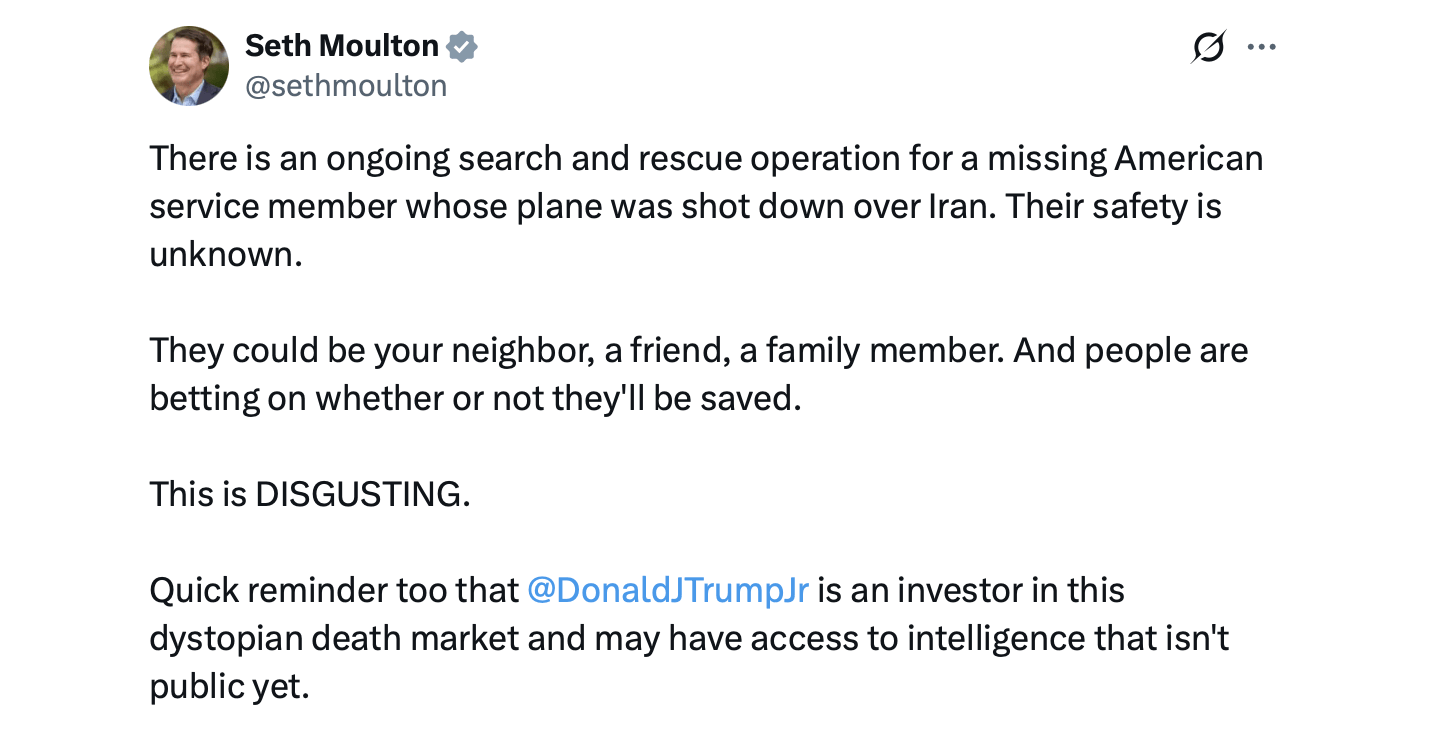
Moulton also pointed out that Donald Trump Jr. is an investor in Polymarket, raising questions about whether platform participants could access non-public intelligence to inform their bets. Other critics on X described the market as a “dystopian death market.” Some lawmakers joined in, questioning the ethics of allowing real-money speculation on live military operations involving U.S. troops.
Moulton followed up by demanding that Polymarket remove approximately 219 active war-related markets it was running at the time. He stated the company’s integrity standards were “severely lacking.”
Polymarket Says the Market Was Removed Immediately for Failing to Meet Internal Integrity Standards
Polymarket responded within hours. In a direct reply on X, the company wrote that the market had been taken down immediately because it did not meet its integrity standards, that it should not have been posted, and that an internal investigation was underway to determine how it cleared the platform’s safeguards.
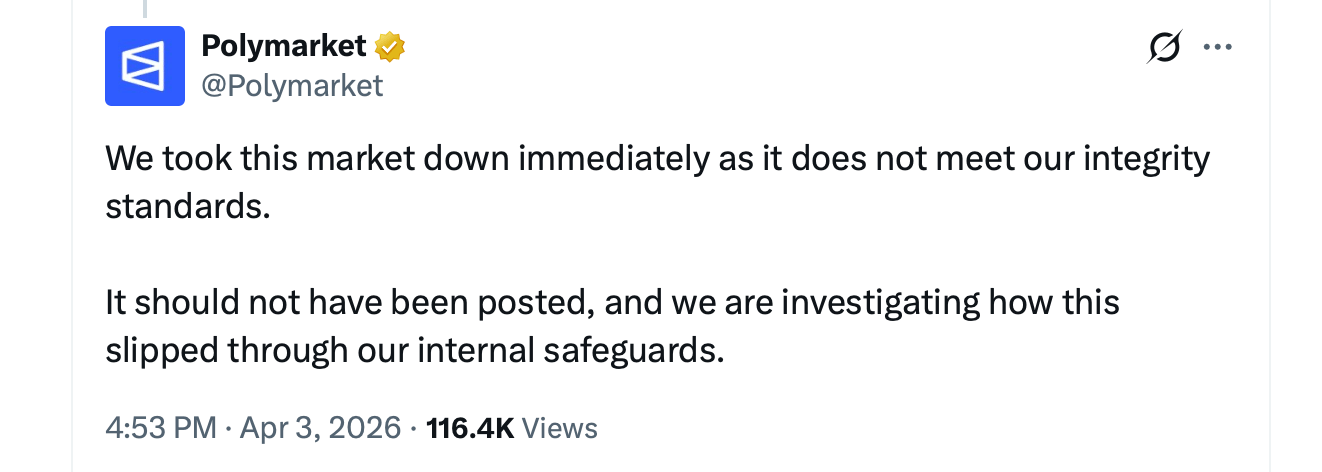
The company did not identify which specific rule the market violated. Its terms of service do not explicitly prohibit all markets involving human life or active conflicts. Polymarket had previously removed a long-running nuclear detonation market after earlier rounds of criticism. Polymarket also stated it collects no fees on geopolitical markets, though that clarification did not satisfy critics who pushed for broader accountability.
The episode has drawn renewed attention to how prediction markets operate when real-time human events intersect with financial incentives. Some critics, including members of Congress and state governors, have called for tighter federal oversight. Defenders of prediction markets argue they aggregate dispersed information, though that argument carried less weight here, given the active combat setting.
Polymarket, Kalshi, and several other prediction marketplaces continue to operate hundreds of geopolitical markets. No further statements on the internal investigation were available as of the latest reports.