Why serious Solana builders outgrow CoinGecko WebSocket, and how Bitquery fills the gap
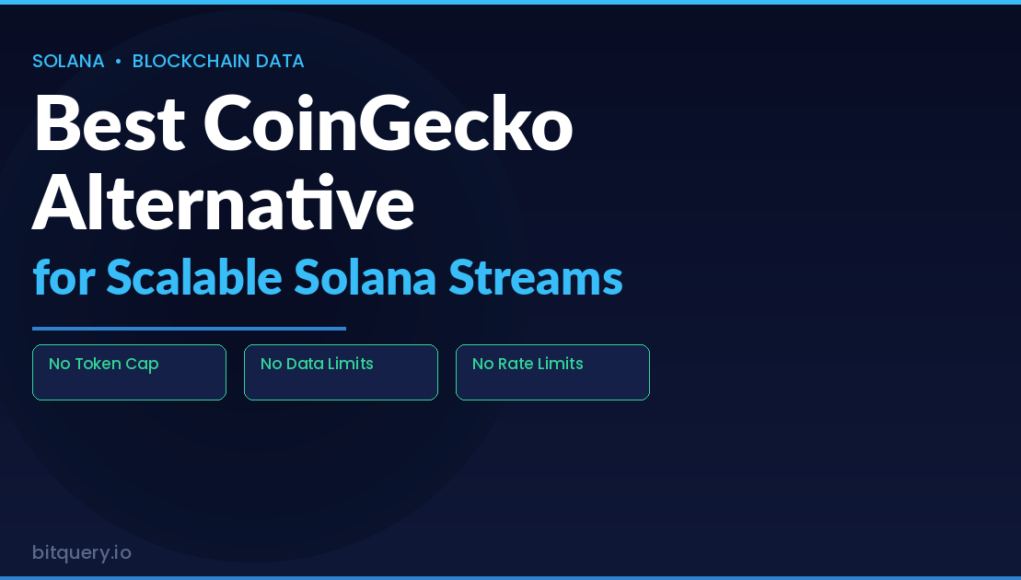
CoinGecko is the go-to for checking a token’s price on a Sunday afternoon. It is not the infrastructure you build a production-grade Solana data pipeline on. Once your use case goes beyond casual lookups into real-time DEX trade surveillance, transaction-level analytics, wallet tracking, or streaming more than a handful of tokens, CoinGecko’s WebSocket offering hits hard architectural walls that cost real money and block real scale.
Solana today handles around $25 billion in daily spot trading volume, surpassing even Binance. Building on-chain analytics, trading bots, or portfolio tools for this ecosystem demands data infrastructure that was designed for streaming from the ground up. This article breaks down exactly where CoinGecko’s constraints are, what they cost in practice across four real customer scenarios, and why Bitquery has become the default alternative for developers who need scalable, on-chain Solana data streams.
The Problem With CoinGecko for Solana Streaming
CoinGecko is, at its core, a price aggregator. It covers 1,700+ centralized exchanges and gives you a clean, normalized price for almost any token. That is genuinely useful for price discovery. But when Solana builders started needing WebSocket access to live DEX trade data covering actual transaction hashes, wallet movements, and liquidity pool events, CoinGecko added a WebSocket product as a beta feature layered on top of an API architecture that was never designed for it.

The result is a product with four structural problems that compound on each other at any meaningful scale.

1. The 1,000-Token Hard Cap
CoinGecko WebSocket allows 100 token subscriptions per channel, per socket connection, with a maximum of 10 concurrent socket connections. The ceiling is 1,000 tokens on the self-serve tier, and there is no path around it without going to enterprise sales.
For a trading bot watching 10 Solana tokens, this is manageable. For a DeFi analytics platform, a multi-chain portfolio tracker, or a token screener, you hit the wall fast and with no warning. CoinGecko’s self-serve tier has no upgrade path, meaning it is enterprise sales or nothing.
2. Credit Bleed: Streaming and REST Share the Same Pool
CoinGecko WebSocket charges 0.1 credits per message, drawing from the same credit pool as your REST API calls. The moment you spin up a live data stream, it competes directly with every other API call your application makes.
At 1 million trades per day, you need approximately 3 million credits per month. Their Pro plan includes 2 million. Overage at $250 per 500K calls adds roughly $500/month on top of the $499 base plan, before counting your REST queries on top. Streaming and querying fight over the same pool. On Bitquery, you pay for a number of streams upfront. There are no per-message charges and no data or rate limits, so volume never creates surprise costs.
3. WebSocket Is Still Beta with No Production SLA
CoinGecko’s main API carries a 99.9% uptime SLA. Their WebSocket product does not. It is explicitly labeled beta with no uptime commitment. For production trading infrastructure, institutional data feeds, or any application where downtime has a direct cost, this is a foundational risk.
4. No Raw On-Chain Data, Only Aggregated CEX Prices
CoinGecko’s price feeds are aggregated prices (CGSimplePrice). You receive a number. You do not get wallet addresses, transaction hashes, contract events, DEX pool states, or liquidity movement data. For anyone building anything beyond a price chart, CoinGecko simply does not carry the on-chain data that Solana analytics requires.
What CoinGecko Actually Costs at Scale: 4 Real Scenarios
The sticker price of a CoinGecko plan does not reflect what you actually pay once the credit math runs. Here is what four representative use cases cost in practice:

The portfolio tracker scenario is particularly instructive: 200 tokens at 10 updates/minute generates 2.88 million credits per day. Against a Pro plan’s 2 million included per month, you blow through the allocation in under 21 hours. The math does not just push you to Enterprise; it forces that conversation before you’ve shipped a single user-facing feature.
The DeFi analytics case hits a different kind of wall: not just cost, but a categorical hard block with no self-serve path forward. Enterprise custom pricing with no public rate card and an unclear WebSocket SLA.
Why Bitquery Is the Right Alternative for Solana Streams
Bitquery is not a price aggregator that added streaming as a beta feature. It is a blockchain data platform built around real-time on-chain Solana data as the core product. Solana is a first-class citizen, covering every major DEX including Raydium, Orca, PumpFun, and others, with pre-parsed, pre-enriched data ready to consume.
Three Streaming Interfaces to Match Your Performance Needs
Bitquery offers three distinct ways to consume Solana streams, each tuned to a different performance profile. See the full API comparison for a detailed breakdown:

Unlike CoinGecko’s single WebSocket beta layer, these are production-grade interfaces used by trading bots, data platforms, and institutional analytics teams. You choose the transport that matches your latency and throughput requirements.
No Token Cap, at Any Scale
Bitquery’s GraphQL subscriptions have no token ceiling. One stream-minute is one stream-minute whether your query matches 10 tokens or 100,000. The DeFi analytics platform that is hard-blocked at 1,001 tokens on CoinGecko has no equivalent ceiling on Bitquery. This is the simplest and most decisive difference.
Straightforward Stream Pricing
On Bitquery, you pay for a set number of concurrent streams. That is the entire model. There are no per-message charges, no data limits, and no rate limits. Your live Solana DEX trade subscriptions run at full speed regardless of volume, and they never compete with your API queries for a shared credit pool. CoinGecko charges 0.1 credits per WebSocket message and caps throughput at every tier. Bitquery does not.
Raw On-Chain Solana Data
Bitquery provides actual blockchain data including transaction hashes, wallet addresses, DEX trade events (buy/sell amounts, token pairs, protocols), liquidity pool states, token mint/burn events, and contract interactions. This is the data layer that trading bots, wallet trackers, and DEX surveillance tools are built on. CoinGecko’s aggregated price feed cannot substitute for any of this.
Supported on Solana out of the box: DEX trades (all major protocols), token transfers, balance updates, DEX pool events, program instructions, token supply updates, block streams, and mempool activity.
For PumpFun tokens specifically, Bitquery streams live USD price, market cap, circulating supply, and bonding curve progress in real time. For any Solana SPL token, the Solana Token Market Cap API provides streaming market cap, fully diluted valuation (FDV), total supply, and OHLC price data. None of this exists on CoinGecko’s WebSocket offering.
Historical + Real-Time on the Same API
Bitquery’s GraphQL API uses the same schema for historical queries and live subscriptions. You can backfill past data and stream new events without maintaining two different integrations. CoinGecko’s WebSocket and REST endpoints are separate products with separate credit pools and separate SLA tiers.
No Infrastructure to Run
Getting raw on-chain Solana data traditionally means running a Solana Geyser plugin on your own validator node, which brings server costs, security overhead, manual scaling, and raw log parsing. Bitquery’s managed infrastructure handles all of this. You get a filtered, pre-parsed, enriched Solana data stream via a single endpoint with no node required and no ops burden.
Streaming Live Solana DEX Trades in Practice
Bitquery exposes Solana data through GraphQL subscriptions over WebSocket. Here is a production-ready pattern for streaming real-time DEX trades across all Solana DEXs.
subscription SolanaLiveDEXTrades {
  Solana {
    DEXTrades {
      Trade {
        Buy {
          Amount
          Currency {
            Symbol
            MintAddress
          }
          Price
          PriceInUSD
        }
        Sell {
          Amount
          Currency {
            Symbol
            MintAddress
          }
          PriceInUSD
          Price
        }
        Dex {
          ProtocolName
          ProgramAddress
        }
      }
      Transaction {
        Signature
      }
      Block {
        Time
      }
    }
  }
}
This subscription streams every DEX trade on Solana in real time, delivering the transaction signature, USD-denominated price (pre-calculated by Bitquery), token mint addresses, and the DEX protocol. All data that CoinGecko does not carry at any price point.
For higher throughput, the same data is available via Kafka topics (JSON or Protobuf) with sub-500ms delivery, or via gRPC CoreCast for HFT-grade latency. You can test and prototype subscriptions live at the Bitquery IDE.
The Bottom Line
CoinGecko built a strong product for its intended purpose: aggregate centralized exchange prices and surface them via a clean API. WebSocket streaming built on top of a per-message credit model is the wrong architecture for high-volume, on-chain Solana data workloads.
Bitquery was built for exactly this. No token cap. Separate streaming credits. Three transport options tuned from dashboard-grade to HFT-grade latency. Raw on-chain Solana data covering every major DEX. Production SLA with managed reliability. Historical and real-time data on the same API.
The arithmetic is unambiguous: CoinGecko gets expensive before it gets capable. Bitquery starts where CoinGecko stops.